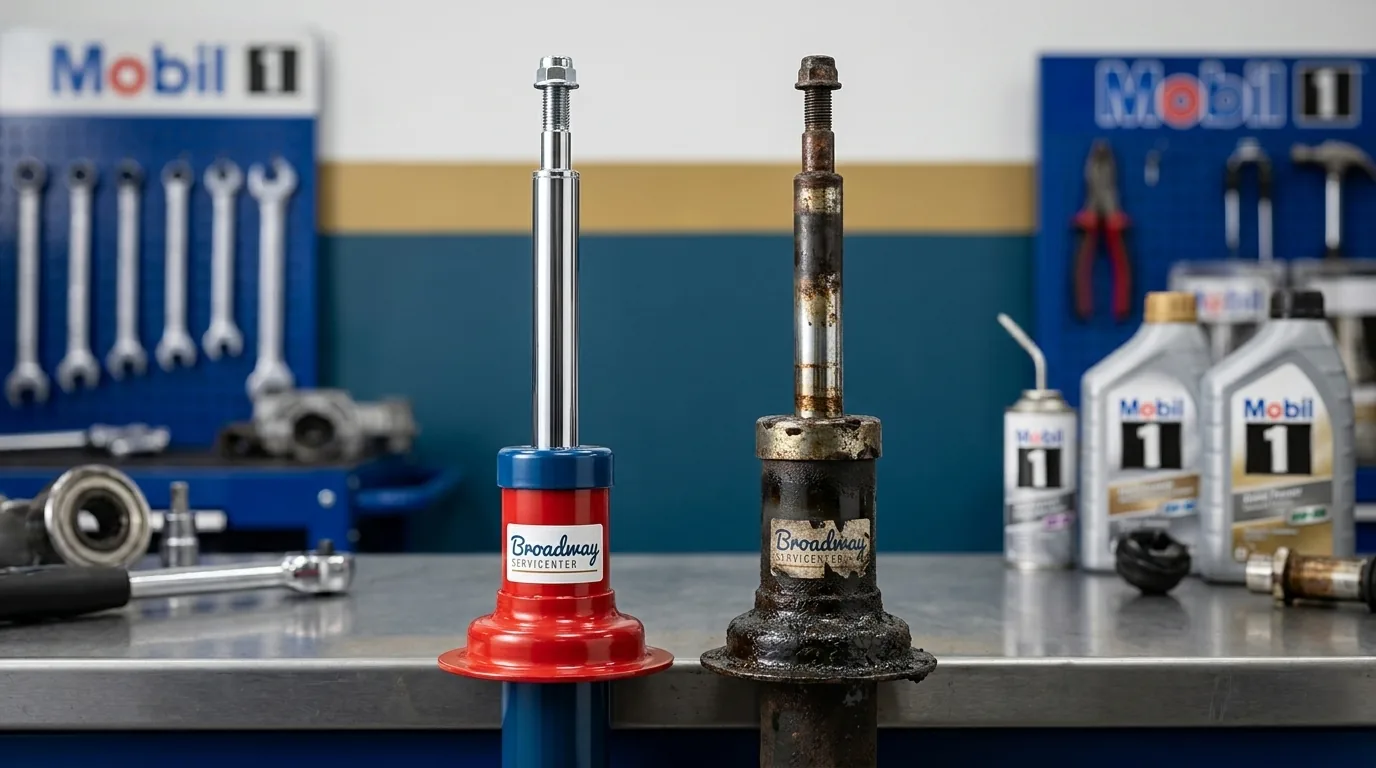
Your shocks or struts may be worn when you notice the car bouncing or rocking after hitting a bump rather than settling quickly, the nose diving forward sharply when you brake, the rear squatting heavily under acceleration, uneven or cupped tire wear, or the car feeling vague and wandering at highway speed. None of these come on suddenly - worn shocks are gradual, which is why many drivers adapt to the change without recognizing it as a problem until it is pronounced.
Bouncing or Rocking After a Bump
A functioning shock or strut damps the spring movement after a bump - it absorbs the initial hit and then controls the rebound so the wheel and body settle quickly. A worn shock lets the car keep bouncing. Hit a speed bump on Old Country Road and the car should settle in one or two cycles. If it keeps rocking for several seconds, the shocks are not controlling the body movement effectively. This is the clearest real-world indicator, and it is easy to reproduce in any parking lot.
Nose Diving Under Braking
When you brake hard, weight transfers to the front of the car. Shocks and struts control how aggressively the nose dips during that weight transfer. A car with worn front struts will pitch forward noticeably on hard braking - more than it used to. This affects braking stability because the front tires are loading unevenly and quickly rather than smoothly. It also extends stopping distance in emergency situations. If the nose dips sharply on aggressive braking, front struts deserve attention.
Cupped or Scalloped Tire Wear
When shocks wear out, tires start to bounce rather than roll with consistent contact. The bouncing creates uneven contact patches - the tire wears heavily where it pounds the road and lightly where it lifts slightly. This creates scalloped or cupped wear - a pattern of high and low spots around the circumference of the tire. You can feel it as a vibration or humming at certain speeds. Once a tire is cupped, it will not smooth out. The tire needs to be replaced, and the shocks need to be addressed or the same thing happens to the next set of tires.
Vague or Wandering Feel at Highway Speed
At highway speed, worn shocks allow the body to move in ways that the steering cannot fully compensate for. The car feels less planted, requires more steering corrections, and drifts slightly with crosswinds or road camber. Many drivers describe this as the car “floating.” On the LIE or Meadowbrook at 65 mph, that vague, wandering feeling is a real handling safety concern - not just a comfort issue.
Why the Old Bounce Test Is Unreliable
The push-down-on-the-bumper test is not a reliable diagnostic. A strut can be worn enough to cause all the symptoms above and still pass the bounce test, because the test does not replicate the dynamic loads the shock experiences at road speed. The real indicators are the behaviors described above - how the car handles bumps, braking, acceleration, and highway driving.
What Shocks and Struts Actually Do for Safety
Most people think of suspension as a comfort system. It is also a safety system. Worn shocks increase braking distance because the tires are not in consistent contact with the road. They reduce handling precision in emergency maneuvers. They accelerate tire wear, which further reduces traction. A car with 100,000 miles and original shocks on Nassau County roads is a car that handles significantly worse than it did at 30,000 miles, whether the driver has noticed it gradually or not.
Struts vs. Shocks - A Quick Distinction
Struts are structural components - they are part of the suspension geometry and bear vehicle weight. Most modern front-wheel-drive vehicles use struts in the front. When you replace struts, an alignment check is required because strut replacement affects alignment angles. Shocks are separate dampers that do not bear vehicle weight - they only control body and wheel movement. Both wear, both affect handling, both are part of what a suspension inspection at Broadway Servicenter in Garden City evaluates.
Typical Lifespan - And Why Nassau County Is Harder
Shocks and struts typically last 50,000 to 100,000 miles. Long Island drivers - with concrete patches, pothole repairs, and freeze-thaw cycle damage on roads like Old Country Road and Hempstead Turnpike - are typically on the lower end of that range. The constant bump-load cycles on Nassau County roads work the hydraulic fluid and seals harder than smooth highway driving would. If your vehicle has over 60,000 miles and suspension has not been inspected recently, it is worth having it looked at.
If your car feels like it is floating or bouncing, a suspension inspection at Broadway Servicenter is the right place to start. 640 Old Country Road, Garden City. Call (516) 681-0122.
Shocks, struts, ball joints, tie rods - complete suspension check at Broadway Servicenter in Garden City, NY.
☎ Call (516) 681-0122 Book Online
Mon - Fri: 8:00am - 5:00pm
Saturday: 8:00am - 3:00pm
Sunday: Closed