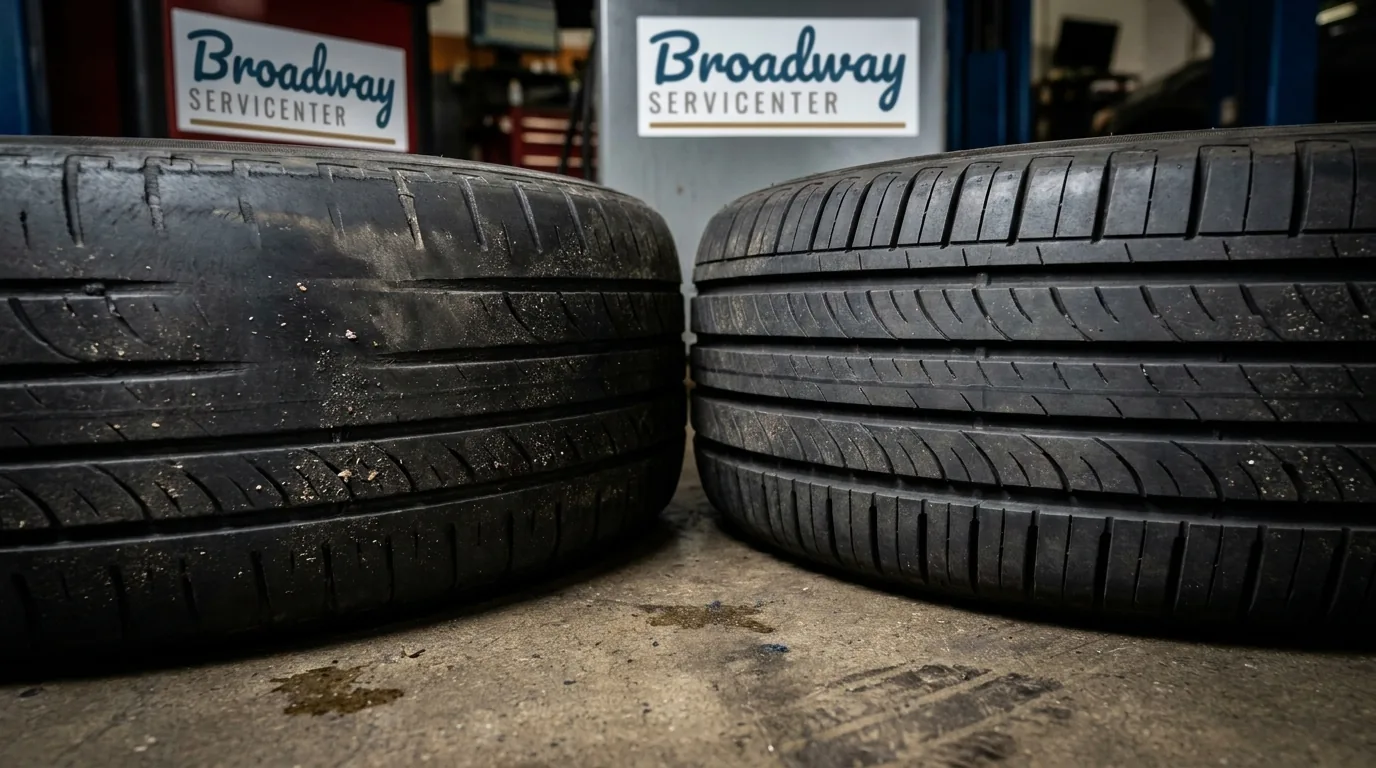
Bad wheel alignment causes uneven tire wear, a steering wheel that pulls to one side, and reduced fuel economy - often before you notice any of these symptoms while driving. Even a misalignment of less than one degree can reduce tire life by thousands of miles and add real cost at the pump. If your tires are wearing unevenly on one edge, or your car drifts when you let go of the wheel, alignment is almost certainly the cause. Here is what is actually happening inside the suspension and what to do about it.
What Wheel Alignment Actually Means
Wheel alignment refers to the angles at which your tires contact the road. Three main angles are adjusted during an alignment service:
- Camber: The tilt of the tire toward or away from the vehicle when viewed from the front. Positive camber tilts the top of the tire outward; negative tilts it inward. Either direction, if excessive, wears one side of the tread faster.
- Toe: Whether the fronts of the tires point toward each other (toe-in) or away from each other (toe-out) when viewed from above. Incorrect toe is the most common cause of feathered or sawtooth tread wear and is also the biggest drag on fuel economy.
- Caster: The angle of the steering axis when viewed from the side. Caster primarily affects steering stability and feel rather than tire wear directly.
4 Signs Your Alignment Is Off
Vehicle Pulls to One Side
The most obvious sign. If you release the steering wheel briefly on a flat, straight road and the car drifts consistently to the left or right, the alignment is likely off. (Check tire pressure first - a significantly underinflated tire can cause the same symptom.)
Steering Wheel Off-Center
If your steering wheel is not centered when driving straight - if it sits a few degrees to the left or right even though you are going straight - you have a toe or caster issue.
Vibration Through the Steering Wheel
Alignment problems can cause vibration, though this is more often a wheel balance issue. If the vibration gets worse at certain speeds, suspect balance first. If it is constant, alignment may be contributing.
Uneven Tire Wear
This is the most damaging symptom - and the one you might not notice until you look. Run your hand across the tread from inside edge to outside edge. If one side is noticeably more worn, or if the tread feels feathered or sawtoothed, alignment (or camber) is wrong.
How Misalignment Destroys Tires
Tires are designed to wear evenly across their full tread width. When alignment pulls even a small portion of the load to the inner or outer edge, that edge carries more friction and heat than it was designed to handle. The result is accelerated wear in a localized area. A tire that should last 50,000 miles can be worn down to the wear indicators on one edge in 20,000 to 25,000 miles - half the expected life.
Toe misalignment is particularly destructive because it causes the tire to scrub slightly sideways with every revolution, even though it appears to be rolling forward normally. This lateral scrubbing generates heat and removes tread in a pattern that looks feathered or saw-toothed when you run your hand across it. You can feel this wear but you cannot see it without looking carefully at the tread.
Long Island’s roads contribute to alignment drift. Potholes on Old Country Road and the surrounding Nassau County streets hit suspension components at the precise angles that knock alignment out of spec. After hitting a significant pothole, or if you notice any of the symptoms above, an alignment check is worthwhile before the tire wear compounds.
The Fuel Economy Hit
Incorrect toe alignment creates rolling resistance - the tires are fighting the direction they are being forced to travel. This resistance means your engine works harder to maintain speed. Studies show that significantly misaligned toe can reduce fuel economy by as much as 10% - not a dramatic number you would notice on one trip, but real money over the course of 15,000 miles. A $100 alignment pays for itself in fuel savings for most drivers.
When to Get an Alignment Check
- Any time you notice pulling, off-center steering, or unusual tire wear
- After hitting a significant pothole or curb
- When installing new tires - protect your investment from day one
- Every 12 months or 12,000 to 15,000 miles as preventive maintenance
- After any suspension or steering component replacement
At Broadway Servicenter in Garden City, we perform computerized four-wheel alignments on all makes and models. We also offer tire rotation, balancing, and new tire installation. Call (516) 681-0122 or walk in Monday through Saturday.
Computerized 4-wheel alignment on all makes and models. Protects your tire investment. Garden City, NY.