Mon-Fri 8am-5pm  ·  Sat 8am-3pm ★ ★ ★ ★ ★   Five-Star Automotive Repair (516) 681-0122
Home/Services/Wheel Balancing
Garden City, NY

Wheel Balancing

Expert Wheel Balancing from ASE-certified technicians. 6-month / 6,000-mile warranty on every job.

ASE Certified Technicians
6-Month / 6,000-Mile Warranty
Free Estimates
Family Owned Since 1967
5.0 Stars · 115+ Reviews
NYS Inspections Available
What We Do

Wheel Balancing in Garden City

Broadway Servicenter offers professional Wheel Balancing for all makes and models in Garden City, NY.

Every repair is backed by our 6-month / 6,000-mile warranty. Honest estimates, no runaround.
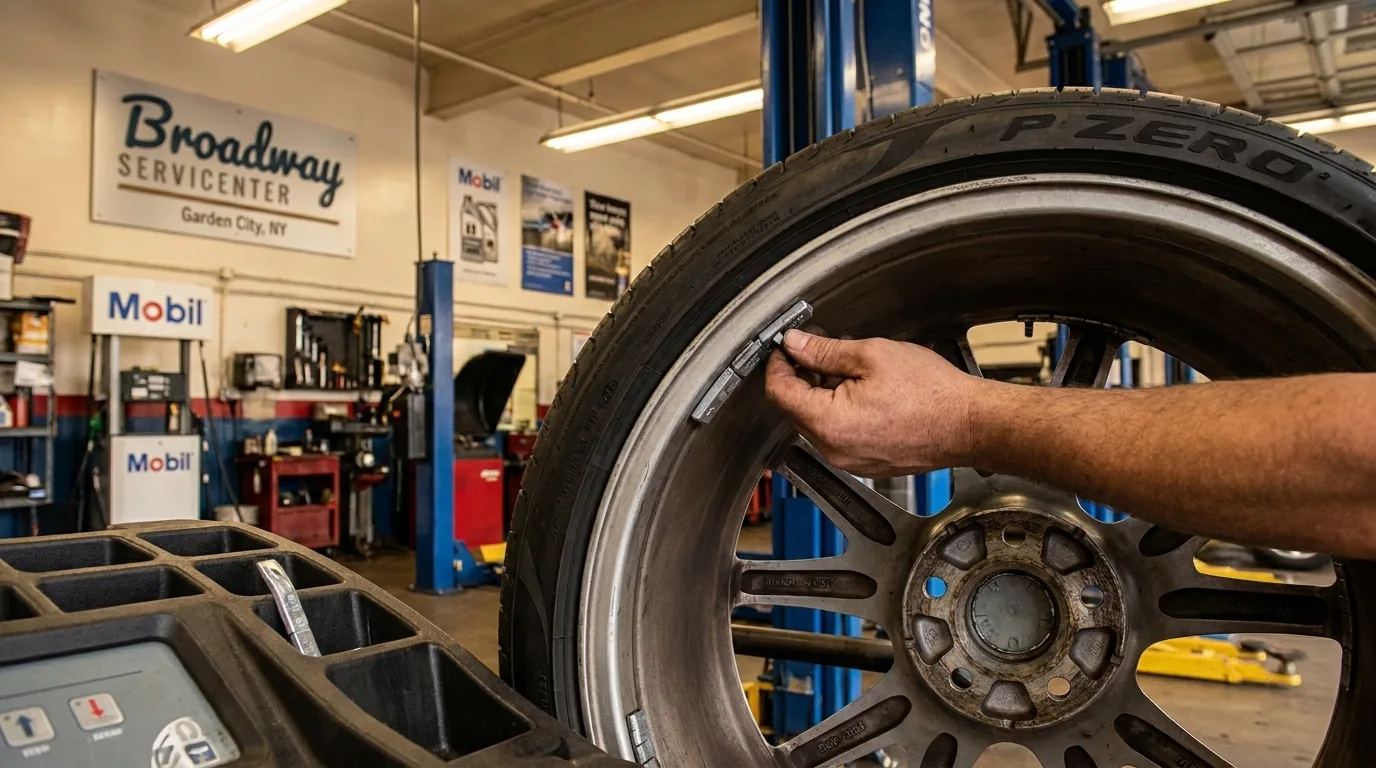
Wheel balancing service at Broadway Servicenter in Garden City, NY
What's Included

Wheel Balancing Services

Dynamic Wheel Balancing

Dynamic balancing spins the wheel and measures imbalance in two planes - both side-to-side and up-and-down - which is the correct method for road wheels. We balance all wheel sizes on all makes and models.

Static Wheel Balancing

Static balancing corrects imbalance in one plane and is used for certain specialty wheels. We determine which method is appropriate for your wheel and tire combination.

🔧

Tire Rotation

Commonly done at the same time as balancing. Rotating tires to equalize wear extends tire life significantly. We follow the correct rotation pattern for your drivetrain configuration.

🔍

Wheel Inspection for Damage

We inspect each wheel for bends, cracks, and runout issues while it is on the balancer. A bent wheel cannot be balanced correctly - it needs to be repaired or replaced.

Wheel Balancing on Long Island Roads

The physics of imbalance: a wheel spinning at 60 mph is rotating roughly 800 times per minute on a typical passenger car tire. An imbalance of one ounce at the rim creates a centrifugal force at that speed that is measurable and noticeable - it gets transmitted through the suspension into the steering wheel and seat as a vibration that worsens with speed. At highway speed on the LIE or Meadowbrook Parkway, an out-of-balance wheel can make a car unpleasant or downright unnerving to drive.

The Long Island road network is specifically hard on wheel balance because of the expansion joints on the expressways and the pothole conditions on local roads. A pothole hit at 40 mph can knock a balance weight off the wheel entirely. When that happens, the wheel that was smooth is suddenly vibrating at highway speed. This is why we see many Nassau County customers who had their tires balanced recently but are experiencing vibration again - a single pothole can undo a balance job.

Cupped tire wear is the consequence of ignoring an imbalance for too long. The wavy, scalloped pattern across the tread is caused by the tire bouncing slightly with each rotation rather than maintaining constant contact with the road. By the time you can see or feel the cupping, the tire is damaged in a way that cannot be reversed - the only fix is tire replacement. A balance check is a short service. Catching the imbalance before it cups the tire saves you the cost of new tires. Call (516) 681-0122 or stop by 640 Old Country Road in Garden City, NY.

FAQ
Wheel Balancing FAQ
What is the difference between wheel balancing and wheel alignment?
Wheel balancing corrects the weight distribution of the wheel and tire assembly. When a wheel and tire rotate, any unevenness in weight distribution creates vibration - a small imbalance of even half an ounce is noticeable at highway speed. Wheel alignment corrects the angles of the wheels relative to the vehicle and the road - camber, toe, and caster - which affects how the tires contact the road surface and how the vehicle tracks straight. Both affect tire life and handling, but they solve different problems. An aligned car can still vibrate from out-of-balance wheels, and a balanced car can still pull or wear tires unevenly from misalignment.
How do I know if my wheels need to be balanced?
The most obvious sign is a vibration in the steering wheel or seat at highway speed - typically starting around 55 to 65 mph and getting worse as speed increases. Cupped or scalloped tire wear (a wavy pattern across the tread) is another sign of an imbalance that has been going on long enough to affect the tire. Any time new tires are installed, balancing is required - a brand new tire is not perfectly uniform in weight distribution.
How often should tires be balanced?
Wheels should be balanced whenever new tires are installed, whenever vibration symptoms appear, and as a general service every 5,000 to 7,500 miles - which aligns with tire rotation intervals. On Long Island roads specifically, balance weights are knocked off by potholes and expansion joints more frequently than on smoother roads. A wheel that was perfectly balanced in September may be off by spring after a rough Nassau County winter.
Can an out-of-balance wheel damage my car?
Yes, over time. An imbalance creates a repetitive vibration that is transmitted through the wheel bearings, ball joints, tie rod ends, and strut bearings on every rotation. That vibration accelerates wear on those components faster than normal driving would. It also creates uneven tire wear - the cupping pattern caused by imbalance damages the tire to the point where the tread surface is no longer repairable and the tire must be replaced. Catching an imbalance early saves the tire and spares the suspension components.
Do you balance wheels after new tire installation?
Yes, always. New tires are balanced as part of every installation at Broadway Servicenter. No tire leaves our shop without being mounted, inflated to the correct pressure, balanced, and torqued to the vehicle's specification. Balancing is not optional on a new tire - a tire that is not balanced after mounting will vibrate immediately at highway speed.

Ready to Book Your Wheel Balancing?

Same-day service on most repairs. Honest estimates, no runaround. 6-month / 6,000-mile warranty.

Ready to Schedule?
Takes 2 minutes. No obligation.
Schedule Appointment