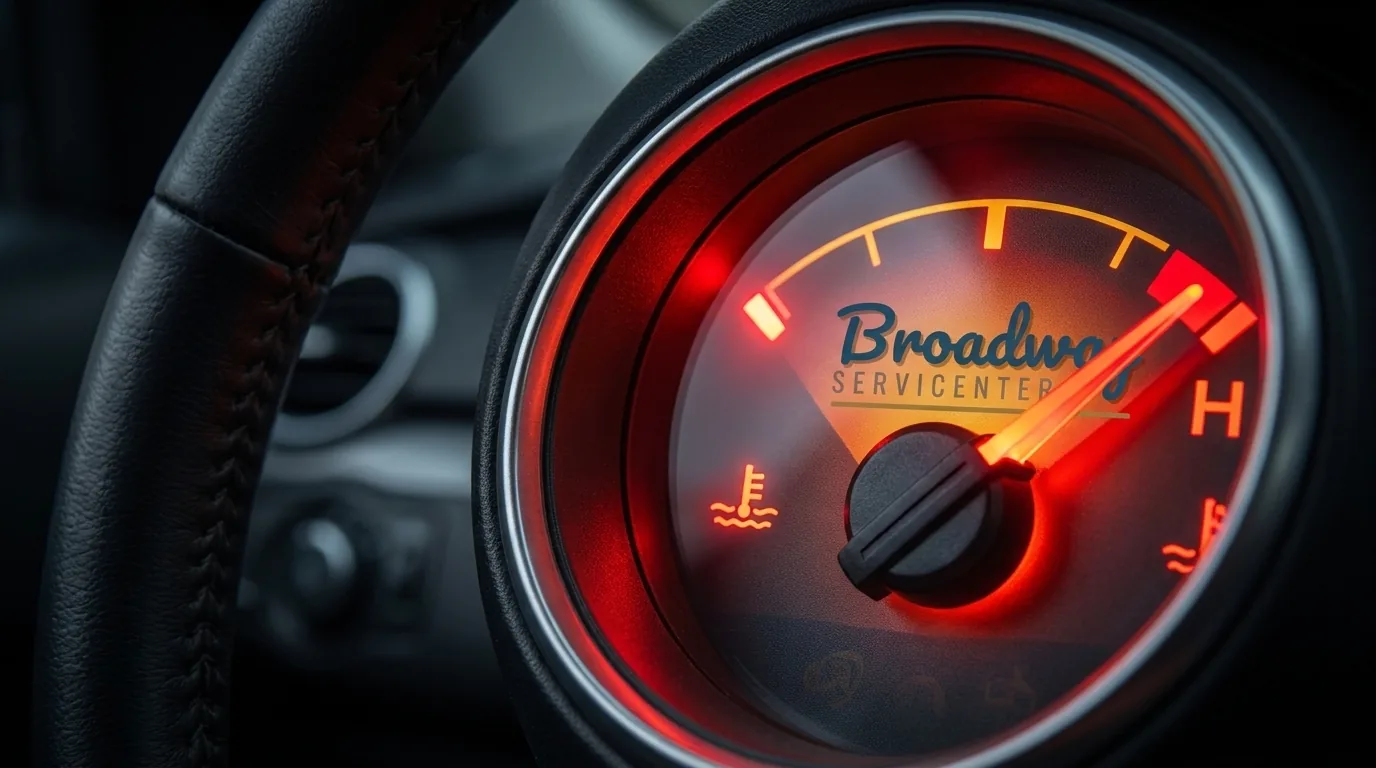
A car overheats when the cooling system cannot remove heat from the engine fast enough. The most common causes are a coolant leak (the most frequent we see), a stuck thermostat, a failing water pump, a clogged radiator, or a broken cooling fan. If your temperature gauge is climbing toward the red zone right now, pull over immediately - do not drive it further. The cost of a tow is a fraction of the cost of a warped cylinder head.
Do Not Keep Driving an Overheating Engine
An engine running above its operating temperature range causes damage fast. Aluminum cylinder heads warp at sustained high temperatures. Head gaskets fail under extreme heat and pressure. Pistons and cylinder walls can score if lubrication breaks down from extreme heat. None of those are quick, cheap fixes - head gasket replacement on many vehicles is a $1,500 to $2,500+ job. The tow to Broadway Servicenter costs a fraction of that. Pull over, shut it off, and let it cool completely before doing anything else.
Coolant Leak - The Most Common Cause
A leak anywhere in the cooling system reduces the amount of coolant available to absorb and transfer heat. Leaks occur at radiator end tanks, coolant hoses, hose clamps, the thermostat housing, the water pump, and - in more serious cases - the head gasket itself. Long Island’s salt air and freeze-thaw cycles accelerate corrosion on older hose clamps and aluminum fittings. A small leak becomes a big problem fast because modern cooling systems operate under 15-16 PSI of pressure. If you see coolant on the ground under the front of the car, or if you smell something sweet when the engine is warm, have it checked before the leak gets worse.
Stuck Thermostat
The thermostat is a small, inexpensive valve that regulates engine coolant flow. When the engine is cold, it stays closed to help the engine warm up quickly. As the engine reaches operating temperature, it opens to allow coolant to flow through the radiator and be cooled. A thermostat stuck in the closed position traps coolant in the engine where it cannot be cooled - temperature climbs fast. A thermostat stuck in the open position causes the engine to never fully warm up, which is a different problem with different symptoms. The good news: a thermostat is one of the least expensive cooling system repairs we do.
Water Pump Failure
The water pump is what actually moves coolant through the engine and radiator. It runs off the serpentine belt or timing belt depending on the vehicle. When the water pump fails - usually from a worn impeller or failing bearing - coolant circulation drops or stops entirely, and engine temperature climbs. An early sign of water pump failure is a small coolant leak from the weep hole on the pump housing. If you see coolant dripping from the front of the engine block, that often points to the water pump before it fails completely.
Clogged Radiator
Over time, scale, rust, and corrosion build up inside the radiator and restrict its ability to transfer heat from the coolant to the airflow passing through it. Nassau County vehicles are particularly susceptible - the constant stop-and-go commuting from Garden City into the city heat-cycles the coolant repeatedly. Old coolant that has never been flushed deposits minerals inside the radiator tubes. The fix is flushing and replacing the coolant, or radiator replacement if the internal restriction is severe enough.
Cooling Fan Failure
Modern vehicles use electric fans to pull air through the radiator when the car is moving slowly or stopped. At highway speeds, airflow through the grille provides enough cooling on its own. At low speeds and in traffic, the fan does the work. A failed fan means the car runs fine on the highway but overheats in stop-and-go traffic - exactly the pattern you see on Old Country Road at 5pm in August. The fan can fail at the motor, the relay, or the temperature sensor that triggers it.
What to Do Right Now If Your Car Is Overheating
- Pull over safely and shut off the engine immediately.
- Do not open the radiator cap - the cooling system is under pressure and boiling coolant will burn you severely.
- Let the engine cool completely - at least 30 minutes, ideally longer.
- Check the coolant level in the overflow reservoir only - not the radiator cap.
- If the reservoir is low and you have distilled water available, add it slowly to the reservoir only.
- Call for a tow if you are not confident the issue is resolved - driving a hot engine compounds the damage.
Never add cold water directly to a hot engine. Pouring cold water into an overheated engine can cause thermal shock - cracking the engine block or cylinder head. Use the overflow reservoir only, and only after the engine has fully cooled.
If you have had your car towed or you drove in while the temperature was elevated, tell us exactly what happened and how high the gauge went. An engine that was briefly over temperature but never in the red is a different situation than one that hit the red and was driven on. The diagnosis changes based on the severity of the overheat event.
Overheating diagnosis at Broadway Servicenter in Garden City. We find the cause before recommending any parts. Call now.
☎ Call (516) 681-0122 Book Online
Mon - Fri: 8:00am - 5:00pm
Saturday: 8:00am - 3:00pm
Sunday: Closed