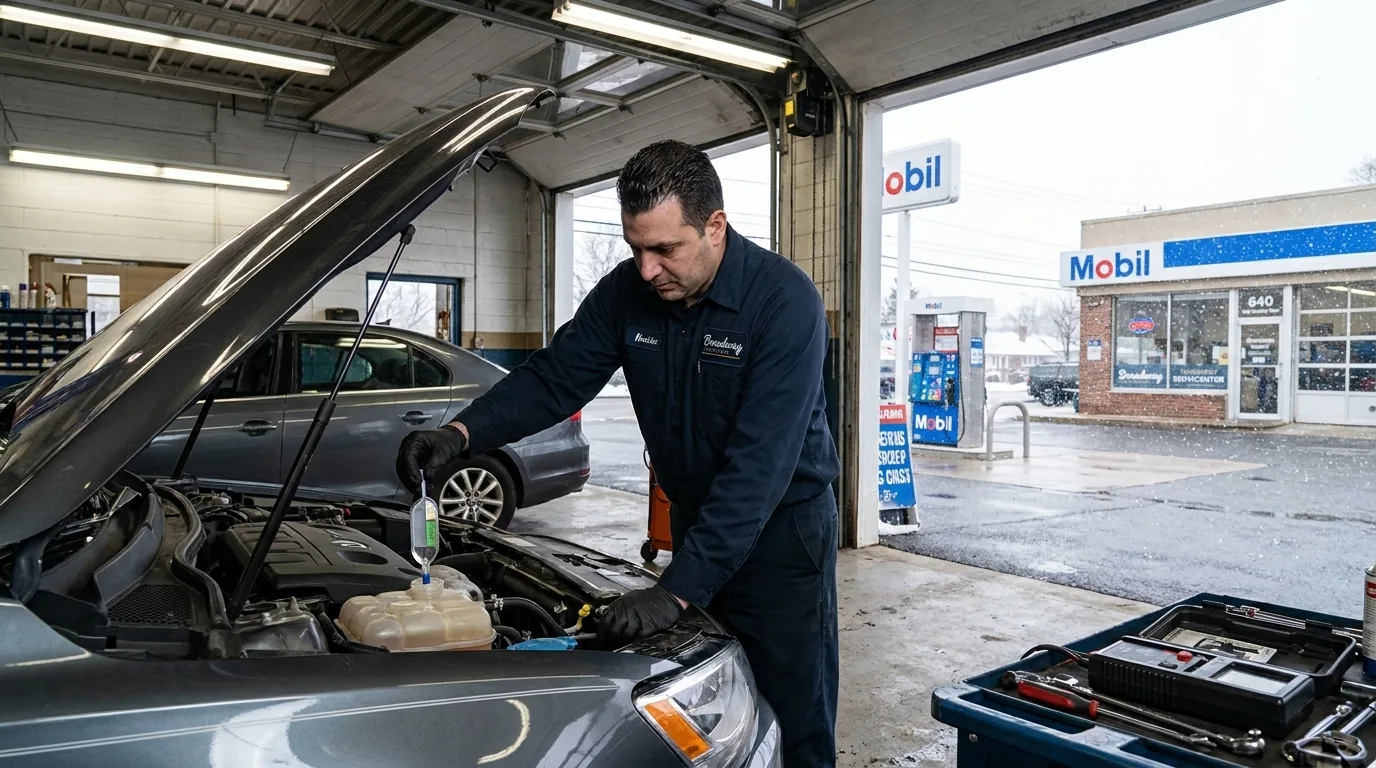
Before the first hard cold snap hits Nassau County, check these five things: your battery (cold kills weak batteries), your tires (tread and pressure drop with temperature), your antifreeze (the mixture must be correct for the temperature range), your wipers (November is too late to discover your wipers smear), and your brakes (reduced traction makes stopping distances longer - worn pads make it worse). Every one of these can be checked in a single visit at Broadway Servicenter in Garden City.
Battery Test - Do This Before October Ends
Long Island winters get cold enough to reveal batteries that were hanging on all summer. A battery at 50% of its rated capacity handles summer heat fine and fails when January temperatures hit the 20s. Cold weather reduces a battery’s ability to deliver current at the exact moment it needs to deliver the most - the cold start. A battery that tests at borderline capacity in October is the battery that strands you in a parking lot in February. If your battery is over 3 years old, get it tested. If it is over 4 years old, consider replacing it proactively before winter regardless of test results. See our article on signs your battery needs replacement for more detail.
Tires - Tread Depth and Pressure Together
Tire pressure drops roughly 1 PSI for every 10 degrees Fahrenheit of temperature drop. A tire properly inflated at 35 PSI on a 70-degree September afternoon may be running at 29 to 30 PSI on a 10-degree January morning. Underinflated tires have worse traction on wet and icy roads and wear unevenly - two problems that compound each other. Check pressure in the morning before driving when the tires are cold. Check tread depth too. A tire with 3/32 inch of remaining tread is a tire that will lose grip on a wet and cold Nassau County road. The quarter test (quarter in the tread with Washington upside down - if you see the top of his head, you are at 4/32 or less) is the quickest field check.
Antifreeze and Coolant Condition
Standard coolant mixed 50/50 with distilled water is rated to approximately -34 degrees Fahrenheit - more than adequate for Long Island winters. The real issue is not freezing protection but coolant condition. Old coolant loses its corrosion inhibitors and can become mildly acidic over time, attacking metal inside the radiator, heater core, and water pump from within. If your coolant is more than 3 years old or over 60,000 miles since the last flush, have it tested. A coolant test strip takes 30 seconds and tells you whether the protection is adequate and whether the pH is in the correct range.
Wiper Blades and Washer Fluid
Wiper blade rubber cracks and hardens from summer UV exposure. Cracked rubber leaves streaks rather than clearing the windshield. You will not know your blades are bad until you need them on a messy November commute and they smear every sweep. Replace blades in October - they are inexpensive and the job takes five minutes. Use washer fluid rated for freezing temperatures. Plain water in a Northeast winter will freeze in the reservoir and spray nozzles. Most washer fluids rated to -20 degrees or better cost no more than standard fluid and handle everything a Long Island winter will throw at them.
Brakes - Winter Demands More from Them
Wet roads, icy patches, and longer stopping distances on cold pavement mean your brakes are working harder going into winter. A car that stops adequately in October may not stop as confidently on a wet January merge onto the LIE if the pads are borderline. Worn pads in winter are a safety issue, not just a maintenance issue. If your pads were getting close in the fall, do not wait until spring. Get them inspected at Broadway Servicenter before the first serious winter weather. The inspection is free.
Oil Viscosity for Cold Weather
If your manufacturer specifies 0W-20 or 5W-30, those designations are designed to flow quickly in cold weather - the “W” stands for winter. Cold-weight oil flows to critical engine components faster on a cold start, which is when most engine wear occurs. If someone has put a heavier oil than specified into your car, cold-weather startup protection may be compromised. Check your owner’s manual or ask us at your next oil change - we look up your VIN to confirm the correct specification before every service.
When to Schedule Your Winter Prep
October is ideal for Nassau County. By mid-November, tire shops are backed up with winter tire installs and auto shops are handling people who waited too long and are now dealing with problems rather than preventing them. A single visit in October handles battery test, brake inspection, tire check, fluid inspection, and wiper blades in under an hour. Make the appointment before the cold - not after the first cold snap when everyone else is calling.
Broadway Servicenter in Garden City can check battery, brakes, tires, and fluids in a single visit. We are at 640 Old Country Road, right in front of Roosevelt Field Mall. Call (516) 681-0122 to schedule your winter prep appointment.
Battery, brakes, tires, fluids - one visit, one stop. October appointments fill up. Call now in Garden City, NY.
☎ Call (516) 681-0122 Book Online
Mon - Fri: 8:00am - 5:00pm
Saturday: 8:00am - 3:00pm
Sunday: Closed