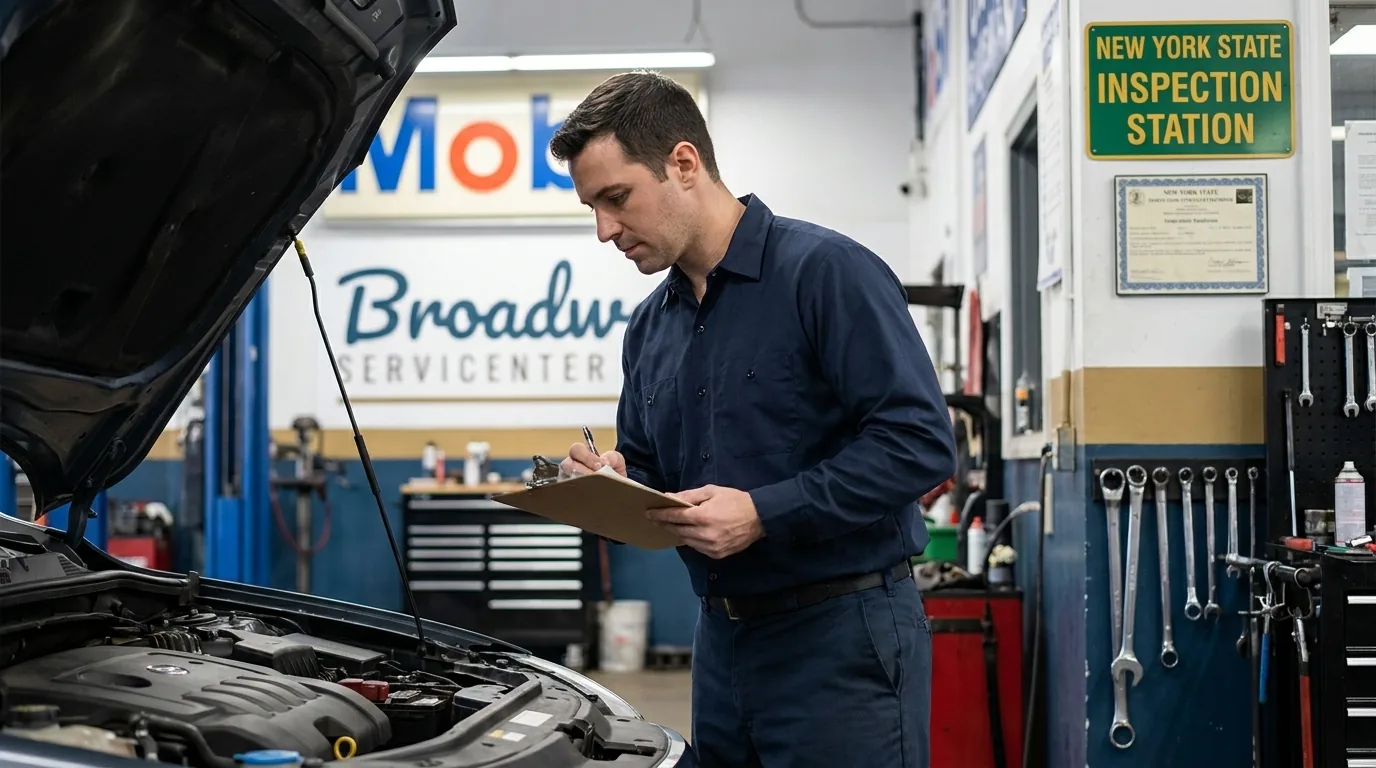
A New York State vehicle inspection checks your brakes, steering, tires, suspension, lights, horn, windshield wipers, seat belts, mirrors, and emissions system. There are two parts: a safety inspection required for all registered vehicles, and an OBD-II emissions scan required for 1996 and newer vehicles. Both must pass for your registration sticker to be renewed. Here is a complete walkthrough of every item the inspector checks, and the most common reasons vehicles fail.
The Two Parts of a NYS Inspection
A New York State vehicle inspection has two separate components:
- Safety inspection: A physical check of all systems related to vehicle control and road safety. Required for all registered vehicles.
- Emissions inspection (OBD-II test): A computerized scan of your vehicle’s onboard diagnostics. Required for model year 1996 and newer vehicles registered in Nassau County and most of New York State.
Both must pass for your vehicle to receive its inspection sticker. Failing either one results in a rejection sticker that gives you 60 days to make repairs and return for a free re-inspection on the failed item.
Safety Inspection: What We Check
New York State law specifies every item that must be inspected. Here is what gets examined:
Brakes
Pad thickness, rotor condition, brake lines and hoses for leaks or corrosion, parking brake engagement, pedal feel.
Steering & Suspension
Tie rod ends, ball joints, control arm bushings, shocks and struts for excessive play or leaking.
Tires
Minimum 2/32” tread depth on all four tires. Sidewall condition checked for bulges, cuts, or separation.
Lights & Signals
All headlights, taillights, brake lights, turn signals, reverse lights, and hazard flashers tested.
Windshield & Wipers
No cracks in the driver’s line of sight. Wiper blades must clear effectively, washer fluid system must operate.
Horn
Must be functional and audible. Checked in every inspection.
Mirrors
Driver’s side mirror required. Passenger side and rearview mirror inspected for cracks and proper adjustment.
Fuel System
Gas cap must seal properly. Visible fuel leaks are an automatic failure.
Emissions Inspection: The OBD-II Test
For 1996 and newer vehicles, the emissions portion connects a scanner to your vehicle’s OBD-II port - the same port used for diagnostic work. The test checks two things:
- Active fault codes: Any stored diagnostic trouble code that relates to the emissions system is an automatic failure. This is why a check engine light almost always means failing inspection. The light means there is an active fault code.
- Readiness monitors: Your vehicle’s computer runs a series of self-tests (readiness monitors) on emissions-related components. All monitors must show “complete” or “ready” to pass. If monitors are incomplete - most commonly after a recent battery disconnect or fault code reset - the vehicle will fail even without an active code.
Important: Clearing a check engine light by disconnecting the battery does not fix the underlying problem. It also resets the readiness monitors, which take 50 to 200 miles of driving to complete. If you clear the light and come in immediately, you will fail on incomplete monitors even if the original fault does not return. Fix the issue first, then let the car drive normally for a week before inspection.
The Most Common Reasons Vehicles Fail
- Active check engine light (most common failure statewide)
- Worn brake pads at or below minimum thickness
- Tires below the 2/32” minimum tread depth
- Cracked windshield in the driver’s line of sight
- Failed or burned-out brake lights or headlights
- Incomplete OBD-II readiness monitors
- Leaking fuel system or loose gas cap
What Happens If Your Car Fails?
If your vehicle fails inspection at Broadway Servicenter, we give you a written list of exactly what failed and what needs to be repaired. You receive a rejection sticker that allows you to legally drive the vehicle to get those repairs done. Return within 60 days with proof of repair (or bring it back to us), and the re-inspection of the failed items is free.
In many cases we can perform the needed repairs the same day and re-inspect immediately. If the repair involves parts that need to be ordered, we will tell you up front before you leave.
How to Prepare for Your Inspection
- Check that your check engine light is off - if it is on, have the fault diagnosed and repaired before coming in
- Walk around your car and test all exterior lights the night before
- Check your wiper blades for streaking or skipping
- Make sure your gas cap clicks tight when you close it
- Do not reset your check engine light right before inspection - let the monitors complete first
Walk-ins are welcome at Broadway Servicenter Monday through Saturday. Most inspections are completed in 30 to 45 minutes. Call (516) 681-0122 to check current wait times.
State-registered facility in Garden City. Walk-ins welcome Mon-Sat. Most done in under 45 minutes.