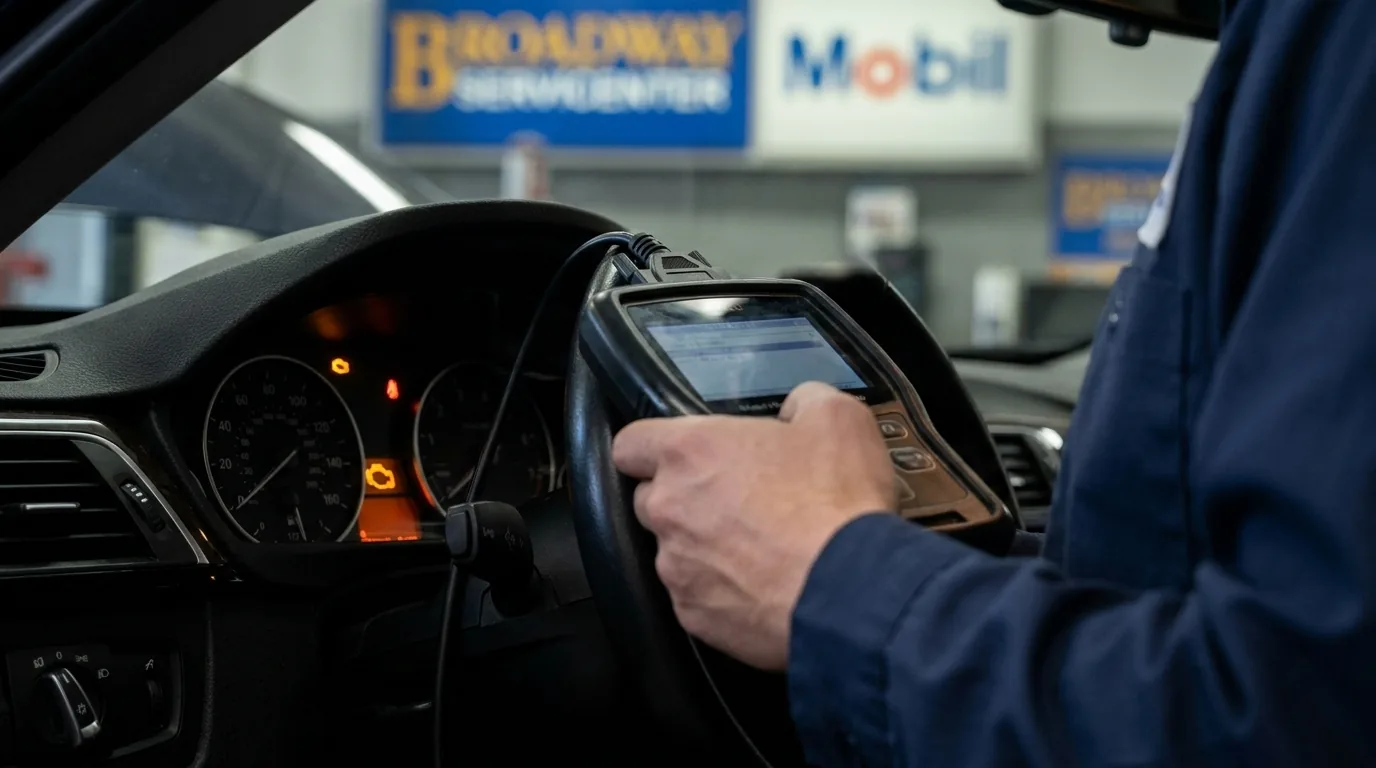
The six most common check engine light causes are a loose or faulty gas cap, a failing oxygen sensor, a worn catalytic converter, a bad mass airflow sensor, misfiring spark plugs or ignition coils, and a leak in the evaporative emission (EVAP) system. Some of these - like a gas cap - cost almost nothing to fix. Others, like a catalytic converter, can be expensive if ignored. Here is how to tell which situation you are in, and which ones actually need immediate attention.
First: Solid vs. Flashing - There Is a Difference
A flashing check engine light is an emergency. It indicates an active engine misfire that is currently happening. Continued driving with an active misfire damages your catalytic converter - a repair that can cost $1,000 to $2,500 or more. If your check engine light is flashing, reduce your speed, avoid hard acceleration, and get the vehicle to a shop or pull over and call for a tow. Do not wait.
A solid, non-flashing check engine light is less urgent. It means the system has detected a fault and stored a code, but the condition is not causing immediate damage in most cases. You should still have it diagnosed within a week or two - not tomorrow morning necessarily, but not three months from now either.
The 6 Most Common Causes
1. Loose or Missing Gas Cap
Urgency: Low
The evaporative emissions system (EVAP) seals fuel vapors inside the tank. A loose or cracked gas cap breaks that seal, triggering codes like P0440 or P0455. Tighten the cap (you should hear it click), then drive normally for a day or two. The light may clear on its own. If it does not clear within 50 miles, have the EVAP system properly tested - the gas cap code can also be triggered by a cracked vapor line or faulty purge valve.
2. Oxygen (O2) Sensor Failure
Urgency: Moderate
Your vehicle has two to four oxygen sensors that monitor exhaust composition and help the engine computer optimize the fuel mixture. A failed O2 sensor triggers codes in the P0130-P0167 range. The engine will continue to run, but fuel economy will drop - sometimes significantly - and the engine may run slightly rich. Replace the faulty sensor promptly. Driving on a bad O2 sensor for a long time can damage the catalytic converter downstream, turning a $150 repair into a much larger one.
3. Catalytic Converter Issues
Urgency: Higher Cost
The catalytic converter processes exhaust gases before they exit the tailpipe. Codes like P0420 or P0430 indicate converter efficiency is below threshold. A failing converter is often the result of an upstream problem - a bad O2 sensor or misfiring engine that was not addressed - so diagnosing the root cause matters. Catalytic converters are expensive ($800 to $2,500 for many vehicles), which makes prevention through proper engine maintenance worthwhile.
4. Mass Airflow (MAF) Sensor
Urgency: Moderate
The MAF sensor measures how much air is entering the engine so the computer can deliver the correct amount of fuel. A dirty or failed MAF sensor causes rough idle, hesitation on acceleration, poor fuel economy, and codes in the P0100-P0104 range. Often the sensor is just dirty and can be cleaned with MAF-specific cleaner rather than replaced outright. Have it tested before replacing it.
5. Spark Plugs or Ignition Coils
Urgency: Do Not Ignore
Worn spark plugs or a failed ignition coil cause misfires - codes like P0300 (random misfire) or P0301 through P0308 (specific cylinder misfire). A misfire means one or more cylinders are not firing properly, which reduces power and fuel economy and - critically - can cause raw fuel to enter and damage the catalytic converter. Plug and coil replacement is a straightforward, relatively inexpensive repair. Ignoring it is not.
6. Thermostat or Coolant Temperature Sensor
Urgency: Moderate
A stuck-open thermostat prevents the engine from reaching proper operating temperature, reducing efficiency and triggering codes like P0128. A faulty coolant temperature sensor gives the computer wrong temperature data, causing incorrect fuel delivery. Either problem will affect fuel economy and emissions performance. Neither is immediately dangerous in most cases, but both should be addressed within a few weeks.
The code the scanner reads is a starting point, not a diagnosis. A P0420 code does not definitively mean your catalytic converter is bad - it means converter efficiency is below threshold, which can be caused by the converter itself, a leaking exhaust manifold, a bad O2 sensor, or an exhaust leak before the sensor. Proper diagnosis means understanding what caused the fault, not just what part the code points to. At Broadway Servicenter, we diagnose before we recommend.
What to Do When the Light Comes On
- If it is flashing: Reduce speed, avoid hard driving, and get to a shop immediately or call for a tow.
- If it is solid: Check your gas cap first (re-tighten it). Note any other symptoms - rough idle, hesitation, reduced power. Bring it in within the week.
- Do not clear the code without diagnosing the cause. Clearing a code with a scanner does not fix the underlying problem. The light will return, and you also reset the readiness monitors, which means you will fail a NYS inspection if you go in too soon.
At Broadway Servicenter in Garden City, we perform computerized OBD-II diagnostics on all makes and models. We explain exactly what the codes mean in plain language and give you a clear quote before touching anything. Call (516) 681-0122 or walk in Monday through Saturday.
We scan your OBD-II system and explain the results in plain language. No guesswork. Garden City, NY.