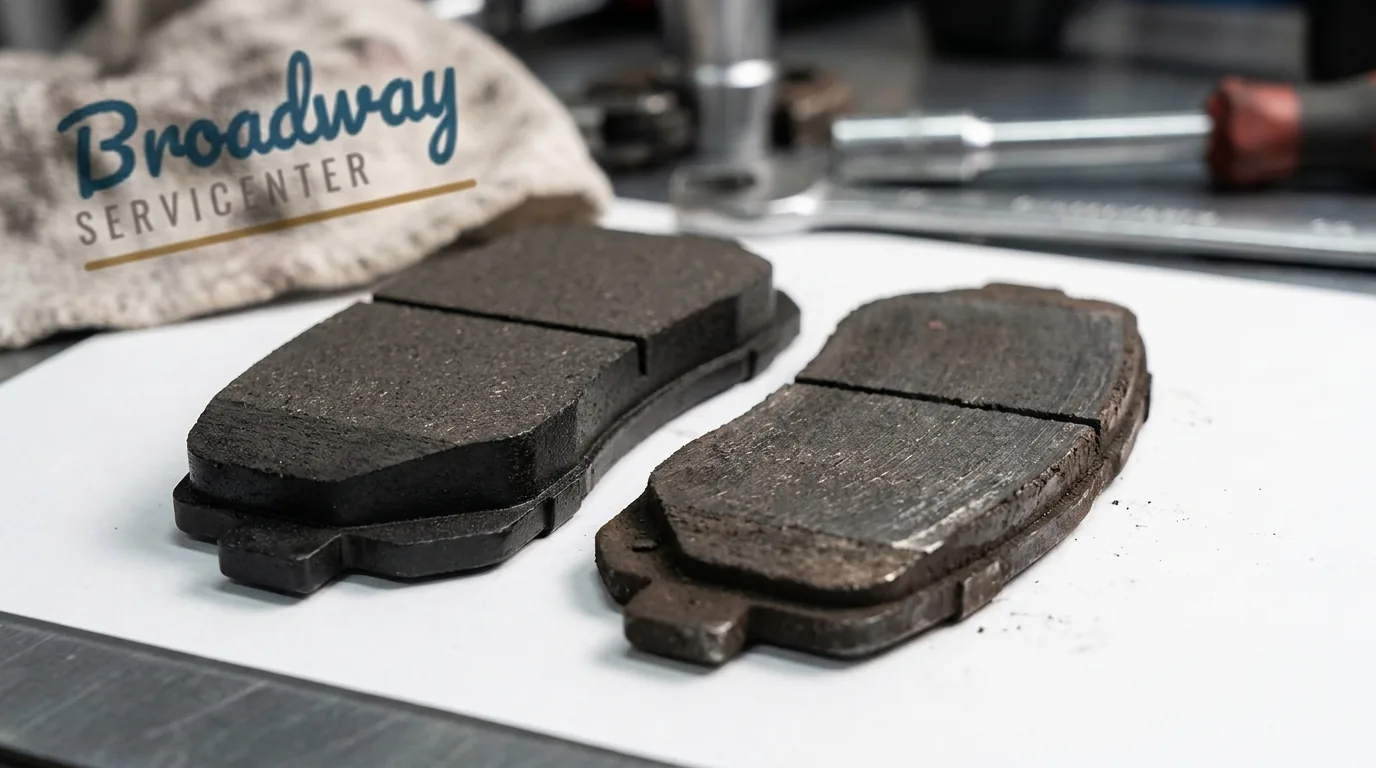
Brake pads typically last between 30,000 and 70,000 miles depending on vehicle weight, driving habits, pad compound, and road conditions. On Long Island - where stop-and-go commuting on Old Country Road, the Meadowbrook Parkway, and the LIE service roads is part of daily life - most Nassau County drivers are on the lower end of that range. Brake pads on a commuter doing 15,000 miles a year in Garden City traffic typically need attention every 2 to 4 years.
Why the Range Is So Wide
A Chevy Suburban commuting in stop-and-go Garden City traffic will go through brake pads faster than a Toyota Camry doing mostly highway miles. Heavier vehicles require more braking force to slow down - more force means more heat, and heat is what wears brake pads. A driver who brakes hard and late generates dramatically more heat per stop than someone who coasts and brakes gradually. Performance brake compounds optimize for stopping power and high-temperature stability, but they sacrifice longevity. All of these factors stack, and that is why the range is so wide.
Nassau County Stop-and-Go Is Hard on Brakes
Every time you brake, you convert kinetic energy - your forward motion - into heat at the brake rotors. More stops equals more heat cycles equals faster pad wear. Old Country Road between Garden City and Mineola has 14 traffic lights in under 2 miles. LIE service road commuters in stop-and-go traffic during rush hour are braking constantly for 30 to 45 minutes at a stretch. School zone patterns in Garden City and surrounding towns add additional cycles. That kind of driving pattern is about the worst thing for brake pad longevity.
What Shortens Brake Pad Life
- Vehicle weight - A full-size SUV or pickup truck wears brakes much faster than a compact sedan. Physics does not negotiate.
- Aggressive driving habits - Hard stops generate far more heat than gradual braking. The heat is what wears the pad material.
- Performance brake compounds - Optimized for stopping power and high temperatures, not for longevity at lower everyday use.
- Towing - A trailer adds significant weight to every stop. Brake wear on towing vehicles can be 2 to 3 times that of the same vehicle unladen.
- Seized caliper - A caliper that does not release fully keeps the pad in light contact with the rotor, causing continuous low-level wear even when you are not braking. One side wears far faster than the other.
How to Tell When Your Pads Are Getting Thin
The brake system gives you warning before complete failure. The first is squealing - a high-pitched sound when you apply the brakes. That squeal is the wear indicator, a small metal tab built into the pad that contacts the rotor when the pad reaches minimum thickness. It is the system working as designed. You have time to schedule service, but do not delay more than a few weeks.
If the squeal becomes grinding - a metal-on-metal sound - the pad material is gone and the steel backing plate is contacting the rotor directly. At that point you are damaging the rotor with every stop. Get it in immediately. At your next NYS inspection, our technicians measure pad thickness and flag pads approaching the minimum 3mm threshold before they become a problem.
Rotors: The Other Half of the Equation
Brake pads wear rotors. Rotors have minimum thickness specifications - if the rotor falls below spec from normal wear, it cannot safely dissipate heat and must be replaced. Running pads until the backing plate contacts the rotor accelerates rotor wear dramatically and often turns what would have been a pad-only job into a pad-and-rotor job. Catching pad wear at the squeal stage usually means rotor resurfacing or no rotor work at all. Waiting until grinding means you are almost certainly replacing rotors too, which significantly increases the repair cost.
Free Brake Inspections at Broadway Servicenter
We check pad thickness, rotor condition and minimum thickness, caliper operation, and brake fluid condition at no charge. Knowing where you stand costs nothing. If your pads are at 5mm, you know you have several months. If they are at 2mm, you know to schedule service this week. Brake service in Garden City, NY - same-day availability on most jobs.
If you hear squealing when you brake, you have time to schedule. If you hear grinding, do not wait - grinding means metal-on-metal contact that damages rotors. Call (516) 681-0122 for a same-day brake inspection.
Pad thickness, rotor condition, caliper function. No charge before any quote. Garden City, NY - same-day service available.
☎ Call (516) 681-0122 Book Online
Mon - Fri: 8:00am - 5:00pm
Saturday: 8:00am - 3:00pm
Sunday: Closed