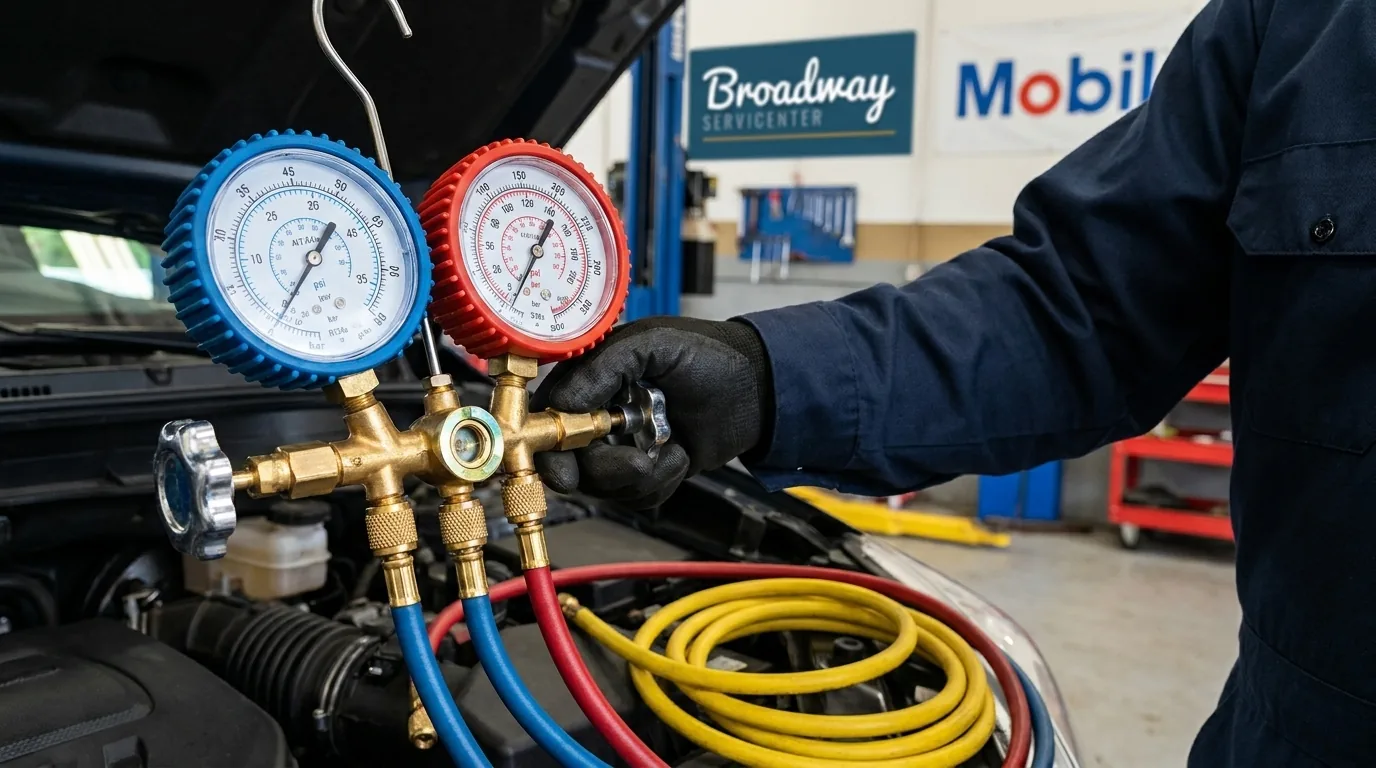
If your car’s AC is blowing warm or barely cool air, the most likely cause is low refrigerant from a slow leak - followed by a failed compressor, a clogged condenser, a faulty expansion valve, or an electrical issue. Most warm AC problems are straightforward to diagnose and fix when caught before the driving season. Here is how to figure out which problem you are dealing with before you bring it in.
How Car AC Works (the Short Version)
Your AC system works by circulating refrigerant between a compressor, a condenser, an expansion valve, and an evaporator. The refrigerant absorbs heat from inside the cabin, carries it outside, dumps it through the condenser, and returns cold. If any part of this loop fails or if refrigerant is low, the system cannot cool effectively. Every cause below is a failure in one of these components or the refrigerant circuit itself.
The Most Common Cause: Low Refrigerant
Low or Empty Refrigerant
Refrigerant does not get used up like fuel - it circulates in a closed loop. If your refrigerant level is low, it means there is a leak somewhere in the system. Simply adding refrigerant without finding and fixing the leak is a temporary fix. The refrigerant will escape again, usually within one to two seasons. Signs of low refrigerant include AC that is barely cool rather than completely warm, inconsistent cooling that gets worse in traffic, and a hissing or bubbling sound from the dashboard area when the system is running.
Failed or Failing AC Compressor
The compressor is the heart of the system - it pressurizes the refrigerant and circulates it. A failed compressor means no circulation and no cooling. Signs of a failing compressor include a loud squealing or rattling noise when you turn the AC on, the AC clutch engaging and disengaging rapidly, or warm air despite full refrigerant. Compressor failure is often the most expensive AC repair. It can also be caused by running a low-refrigerant system too long, which damages the compressor from lack of lubrication.
Clogged or Blocked Condenser
The condenser sits in front of your radiator and releases heat from the refrigerant to the outside air. If it is physically blocked by debris (leaves, road film, bugs) or internally restricted, it cannot shed heat efficiently. The refrigerant stays warm and so does your cabin. A clogged condenser is more common in older vehicles and often shows up as AC that works fine at highway speeds but struggles in slow traffic - because at low speeds there is less airflow across the condenser.
Dirty or Clogged Cabin Air Filter
This is the easiest and cheapest cause on the list. If the cabin air filter is clogged with dust and debris, airflow through the evaporator is restricted and the air reaching you will be reduced regardless of how cold the refrigerant is. Many drivers go years without replacing the cabin air filter. Check yours - it is usually behind the glove box and takes about five minutes to access. If it is gray and matted with debris, replace it. You will notice the difference immediately in both cooling and air quality.
Expansion Valve or Orifice Tube Problems
The expansion valve controls refrigerant flow into the evaporator. If it sticks open, the evaporator floods with liquid refrigerant and the system loses efficiency. If it sticks closed, very little refrigerant reaches the evaporator and cooling drops dramatically. This is a less common cause but worth knowing - it can mimic a low-refrigerant diagnosis if not tested properly.
What You Can and Cannot DIY
Topping off refrigerant with a can from an auto parts store can give you temporary cooling if the leak is minor and slow. However, modern refrigerants (R-1234yf in post-2017 vehicles, R-134a in older ones) require specific equipment to add properly and legally. Overcharging an AC system is worse than undercharging it - too much refrigerant can damage the compressor. Diagnosing the actual leak source requires a UV dye test or an electronic leak detector.
If your AC stopped working suddenly rather than gradually getting worse, that is more likely a compressor failure or a blown fuse than a refrigerant leak. A gradual decline over weeks or months points toward a slow leak. This distinction helps us narrow down the diagnosis quickly.
At Broadway Servicenter in Garden City, we offer a free AC system diagnosis with any AC service or repair. We test system pressure, check for leaks, and inspect all components before recommending any work. We service both R-134a and R-1234yf systems on all makes and models. Call (516) 681-0122 or walk in Monday through Saturday.
We test system pressure and check for leaks before recommending any work. Garden City, NY.